
1. Introduction
A new legislative development in the Netherlands has raised significant concerns regarding the taxation of financial assets: a novel tax framework that could fundamentally alter long- term financial planning and potentially trigger forced liquidation cascades, cross-border contagion risks, and structural loopholes that advantage wealthy investors while penalising ordinary retail savers. The broader concern is that this law may serve as a preliminary test, a “pilot programme”, aimed at generating new state revenue, but in a highly risky manner that ultimately risks eroding ordinary individuals’ ability to build intergenerational wealth.
Consider a standard financial scenario: an individual with a regular job, a family, and a mortgage diligently manages savings over two decades, investing primarily in traditional assets such as equities. Suppose their portfolio appreciates from €50,000 to €100,000 within a single year. If no assets are sold, no capital gain is realised, and no cash is received, the investor allows compound interest to function uninterrupted. However, under the proposed system, a tax liability arises on this paper gain, even in the absence of any sale. For instance, a tax bill of €16,000 could be due on a profit that exists only as a computer screen valuation on a specific date. This scenario is no longer hypothetical; it has become law in the Netherlands.
2. Legislative Background and Mechanism
For years, the Dutch tax system operated on a presumptive return model, where the gov- ernment assumed a fixed 4% annual return on investments and taxed that assumption, irrespective of actual performance of the investment, even in the case of a loss. In December 2021, the Dutch Supreme Court ruled this system unconstitutional, stating that it violated property rights under the European Convention on Human Rights, as it taxed income never received. This decision created an immediate fiscal shortfall of approximately €2.3 billion annually.
Faced with two options, developing a conventional system taxing only realised gains (as in most developed nations) or taxing unrealised gains, the Dutch authorities chose the latter. From 1 January 2028, fiscal residents of the Netherlands will be subject to a 36% tax on all financial asset returns, including interest, dividends, realised gains, and critically, unrealised gains. If an investor’s shares increase in value from €100,000 on 1 January to €110,000 on 31 December, the 36% tax applies to the €10,000 difference, regardless of whether any position has been closed. An exemption applies only to the first €1,800 of annual returns (€3,600 for married couples). Losses may be carried forward, but only losses exceeding €500, and crucially, they cannot be carried backward. Consequently, if an investor pays €10,000 in tax on unrealised gains in 2028 and the market collapses in 2029, the state does not refund the payment; the loss can only offset future gains, by which time the compounding damage is irreversible.
3. Practical Consequences for Investors
A concrete example illustrates the impact. An investor begins 2028 with €50,000; by year- end, the portfolio has grown to €100,000 (a €50,000 unrealised gain). For a married couple, after the €3,600 exemption, the taxable base is €46,400, resulting in a €16,700 tax liability. If the market subsequently crashes by May (when the tax is due), and the portfolio falls to €60,000, the tax obligation remains unchanged. To pay it, the investor is forced to sell assets, reducing the portfolio to approximately €43,000. Despite no active trading error or panic selling, the investor ends with less capital than at the start, solely due to taxation on a gain that has since evaporated.
This is not merely theoretical. By October 2025, indirect crypto investments held by Dutch entities reached approximately €1.2 billion, up from €81 million in just five years, represent- ing paper gains soon to be taxable. Consequently, many cryptocurrency holders are already considering leaving the jurisdiction, with an exodus beginning before the law’s 2028 effective date.
4. The Effect of Inflation
Inflation exacerbates the problem. With average European inflation exceeding 4.5% annually over the last five years, a nominal return of 8% results in a real return of approximately 3.5%. However, the 36% tax is levied on the nominal 8%, yielding an effective tax rate of over 70% on the real gain ( 36% of 8% equals approximately 2.9%; on a real return of just 3.5%, this 2.9% tax represents an effective rate of roughly 83%, meaning the state captures the vast majority of the investor’s actual inflation-adjusted return). A significant portion of the “gain” merely compensates for the erosion of purchasing power, yet it is taxed as income. Moreover, if an investor must sell a portion of an asset holding each year to pay taxes on revaluation, the holding will eventually diminish to zero. The tax does not take a slice of the gain; it consumes the underlying asset.
5. Disparities in Asset Treatment
The legislation applies unevenly across asset classes. Shares, bonds, ETFs, and cryptocur- rencies are taxed annually on unrealised gains. However, real estate, qualifying startup shares, and luxury goods (e.g., yachts, luxury cars for personal use) are exempt or follow realisation-based taxation. The official justification is that forcing taxpayers to pay tax on
illiquid assets would create severe problems, because if an asset such as a private company stake, artwork, or real estate appreciates in value but generates no cash flow, the taxpayer has no liquidity with which to pay the tax; they would be forced to sell a portion of the asset, often at an inopportune time or at a distressed price, or go into debt to satisfy the tax liability, which undermines the very logic of a tax system that presumes ability to pay. Yet liquid assets such as shares and ETFs did not receive the same consideration.
Furthermore, a 5% rule applies: holders of at least 5% of a company, that fall under the class of “substantial interest holders”, are taxed upon realisation, granting them control over timing. Small retail investors, by contrast, are taxed annually on unrealised gains without choice or control. The law thus disproportionately affects ordinary investors, not the wealthy.
6. Arbitrage and Avoidance Mechanisms
The legislation creates structural loopholes. For assets without continuous market prices, such as artwork, the value is declared by the taxpayer himself. A painting purchased for €20,000 can be declared as still worth €20,000 the following year, resulting in no taxable gain and therefore no tax due. Alternatively, the taxpayer could declare a lower value, such as €10,000, thereby artificially generating a €10,000 capital loss on paper, which creates a corresponding tax credit that can be used to offset unrealised or realised gains on other assets, reducing the overall tax liability without any actual economic loss. The tax authority has no means to verify the value of unlisted assets. Luxury yachts and cars are entirely exempt, and, even more, interest on loans used to purchase them is deductible. The law consequently penalises productive investment while subsidising luxury consumption.
Moreover, the Dutch tax system is divided into three “boxes”. Box 1 taxes labour income. Box 2 applies to substantial shareholdings (typically 5% or more of a private limited com- pany, or BV – besloten vennootschap); within Box 2, gains are taxed only upon realisation, losses can be carried backward, and taxation can be deferred indefinitely. Box 3 taxes personal savings and investments held directly by individuals; under the 2028 law, Box 3 imposes a 36% tax on unrealised annual gains with no backward loss compensation. Basi- cally, investors can transfer assets into a BV, thereby moving from Box 3 to Box 2. Within a BV, gains are taxed only upon realisation, losses can be carried backward, and taxation can be deferred indefinitely. Wealthy investors with access to legal and accounting consultancy can legally avoid the Box 3 unrealised gains tax entirely. Those without such resources, ordinary savers with ETFs and shares, bear the full burden. This is not a hypothetical scenario.
A wave of Dutch investors is already shifting their assets into newly corporate structures created solely to escape Box 3 and the 36% unrealised gains tax. The transition between Box 3 and Box 2 is remarkably easy, as the law creates a structural fiscal arbitrage. The result is predictable: those who can afford a qualified accountant and a corporate entity can legally opt out of the tax; the ordinary saver with a modest brokerage account and a few ETFs cannot, and therefore suffers the full impact of the legislation once again.
7. Forced Liquidation Contagion
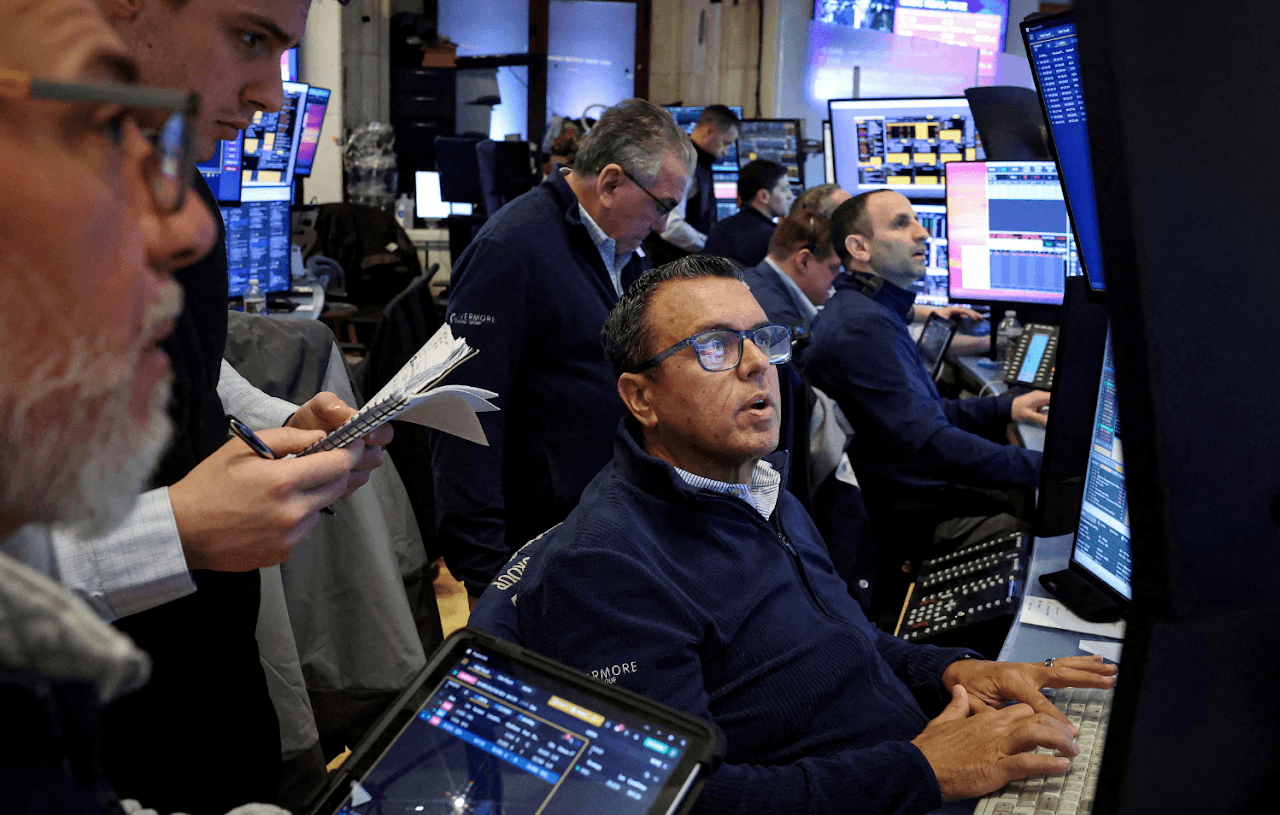
A significant cross-border risk arises from forced liquidation contagion. When multiple taxpayers are required to pay a tax on unrealised gains at the same calendar deadline, the forced selling to generate liquidity creates a cascade of downward price pressure. Each sale drives the market price lower for subsequent sellers, yet the tax obligation remains fixed at 36% of the original paper gain calculated at the beginning of the tax period. Consequently, later sellers receive progressively less from their sales while owing the same nominal tax amount, potentially resulting in a tax liability that exceeds the remaining value of the asset, leaving the investor in debt to the state despite having made no active trading error. This chain reaction is not driven by bad corporate earnings or panic, but by forced government- impelled liquidation.
The most widely held stocks by Dutch citizens is ASML, the world’s sole producer of ad- vanced semiconductor lithography machines, a company essential to the global technology supply chain. ASML is not merely a Dutch stock; it is held in almost all pension funds, ETFs, and institutional portfolios across the entire planet. Any globally diversified portfolio, whether managed in Milan, Munich, or Madrid, almost certainly contains ASML indirectly through index funds or ETFs. This is where the Dutch tax law ceases to be a domestic issue and becomes a cross-border threat. When thousands of Dutch investors are forced to sell their ASML shares simultaneously to pay taxes on unrealised gains, the resulting liquidation cascade will drive down the price of ASML regardless of its underlying business performance. That price drop does not respect borders.. This is the principal cross-border risk: forced selling contagion travels instantly through globally traded assets.
8. European and Comparative Context
No other European country currently taxes unrealised gains. Norway taxes capital gains upon realisation; Germany applies a flat 25% upon sale; France, Austria, Denmark, and Italy all await realisation. No functioning jurisdiction has successfully implemented an unrealised gains tax. The Netherlands previously attempted the presumptive return system in 2001, which was dismantled by the Supreme Court. The current law could be a variation of the same error.
Most political parties in the Dutch parliament favoured a realisation-based system, but that would collect revenue later, creating a budget shortfall in the initial years. The decision was therefore fiscal rather than doctrinal: confronted with an immediate budget shortfall, the government prioritised liquidity over structural coherence, adopting a system that accelerates tax collection notwithstanding its acknowledged economic distortions.
9. Implications for Other European Investors
Two principal implications arise for investors outside the Netherlands. First, this law es- tablishes a European precedent. If it withstands legal challenges, other countries facing budget pressures may consider similar measures, particularly within a context of EU fis- cal harmonisation, automatic data exchange on crypto assets (DAC8, CRS 2.0), and the proposed Savings and Investment Union, which seeks more centralised control over Euro- pean capital. The risk of regulatory contagion is real. Second, forced liquidation contagion has no borders. Investors holding global ETFs, index funds, or individual European stocks are exposed not because their own government taxes unrealised gains, but because another country’s government may force mass selling of the same assets.
10. Conclusions
The world is dividing into two categories of jurisdictions. On one side, countries compete for capital by offering clear rules, predictable tax treatment, and respect for long-term invest- ment horizons. On the other side, countries introduce fiscal measures that create regulatory uncertainty, repelling patient capital. Capital moves at the speed of a wire transfer, yet some governments continue to act as if it were captive. This unpredictability is itself a competitive disadvantage; capital will flow toward jurisdictions that respect the distinction between realised and unrealised gains, leaving behind those that do not. The Dutch ex- periment with taxing unrealised gains represents more than a domestic fiscal adjustment; it is a potential turning point in European tax policy. By prioritising immediate revenue over economic rationality, the law creates perverse incentives, penalises small savers, and introduces systemic risks that cross borders with ease. Whether other European nations will follow this precedent remains uncertain. What is clear, however, is that capital is mobile, patient, and unforgiving of structural incoherence. Jurisdictions that ignore this reality may find that the revenue they gain in the short term comes at the cost of the long-term wealth creation they ultimately depend upon.