

The classic "two-egg problem" provides a powerful model for strategic decision-making. The setup is simple: you have two identical eggs and a 100-story building. An egg that survives a drop can be reused, but one that breaks is lost. The objective is to find the highest floor from which an egg can be dropped without breaking, by devising a strategy that minimizes the number of drops required in the worst-case scenario. This problem, often used to introduce the elegance of dynamic programming [1], serves as a metaphor for allocating scarce and fragile resources—be it R&D budgets or elite team time—amid deep uncertainty [3]. The eggs are your critical, exhaustible resources and the goal is to devise a testing strategy that ensures a predictable operational cost against asymmetric outcomes.
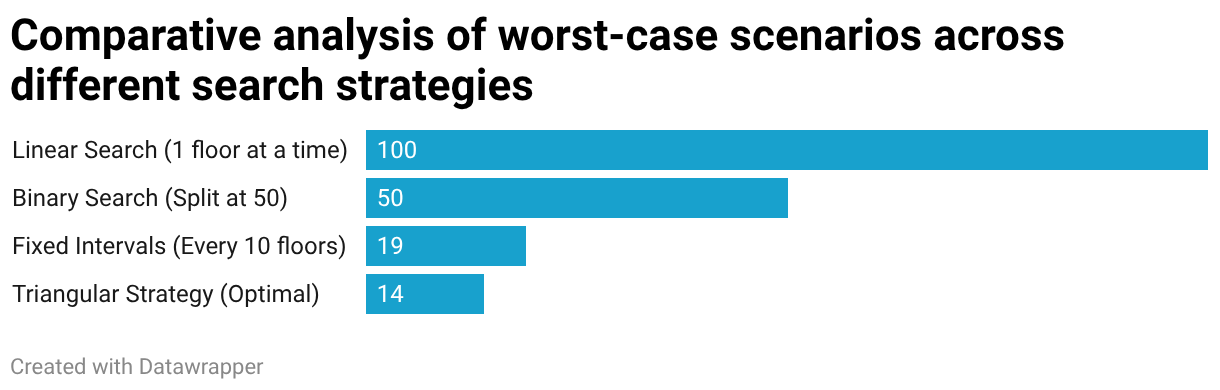
Intuitive approaches often fail because they don't properly hedge against risk. A binary search (starting at floor 50) seems efficient, but it is dangerously flawed. If the first egg breaks, you are left with one egg to test the remaining 49 floors one by one, leading to a catastrophic worst-case of 50 attempts. Another seemingly logical method is testing at fixed intervals, such as every 10 floors (10, 20, 30...). This is an improvement, but it creates a significant imbalance. If the breaking point is floor 99, this strategy requires 10 drops to test up to floor 100 (where the first egg breaks), and then up to 9 more drops with the second egg. The total is 19 attempts in the worst case—far from optimal. Such inefficiencies in searching and sorting through possibilities are central themes in the analysis of algorithmic complexity [2].
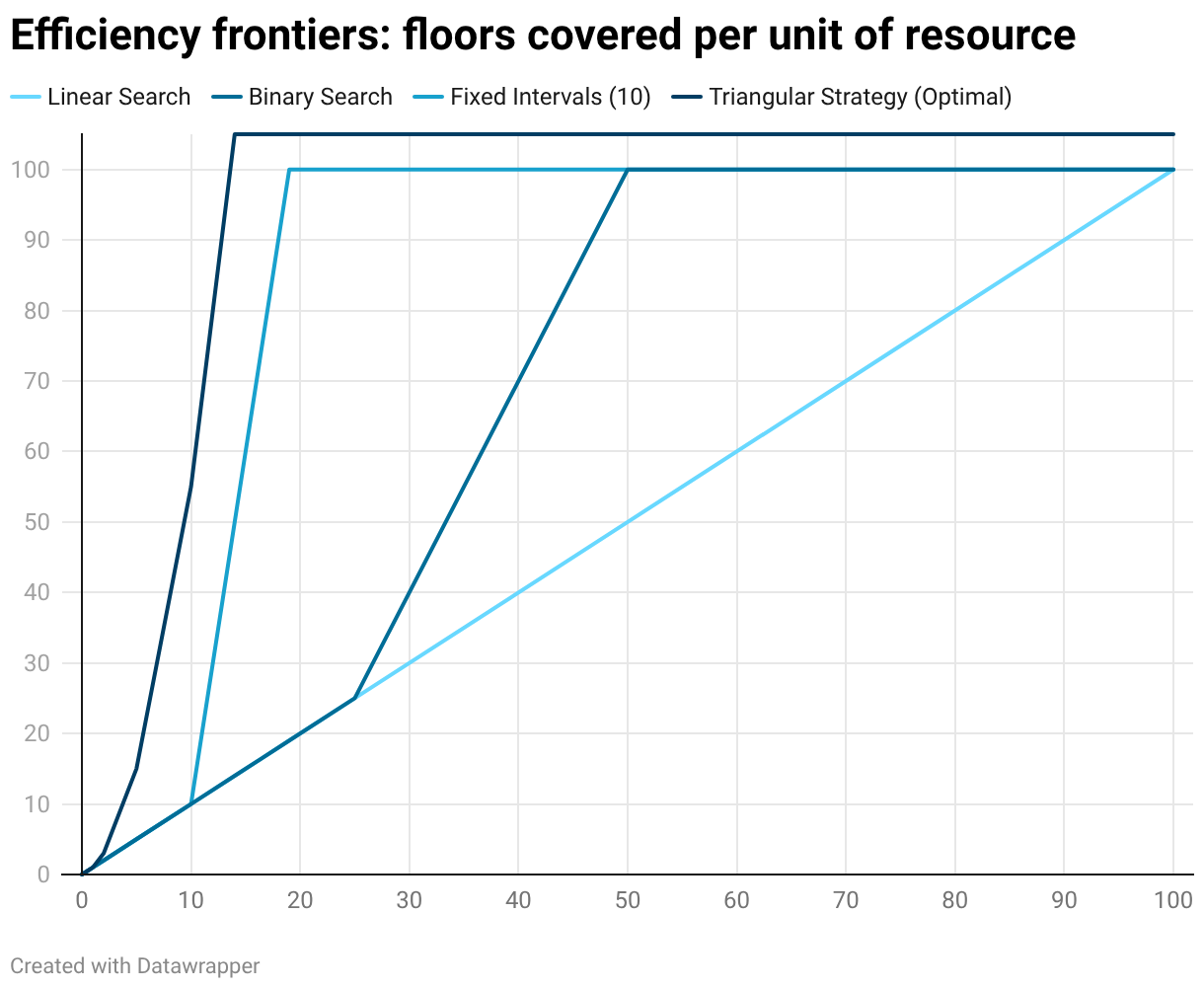
The superior strategy optimizes for the worst-case, not the average. It seeks to make the maximum number of drops constant, regardless of where the egg breaks. This leads to a solution based on triangular numbers. You make the first drop from a floor *x*, where *x* is the maximum number of attempts you are willing to tolerate. If it breaks, you have *x - 1* attempts left for the floors below. If it survives, you move up *x - 1* floors for the next drop. To cover 100 floors, we solve for *x* in the inequality:
The smallest integer solution is 14. This mathematically guarantees a solution within a maximum of 14 attempts, establishing a predictable ceiling on resource expenditure.
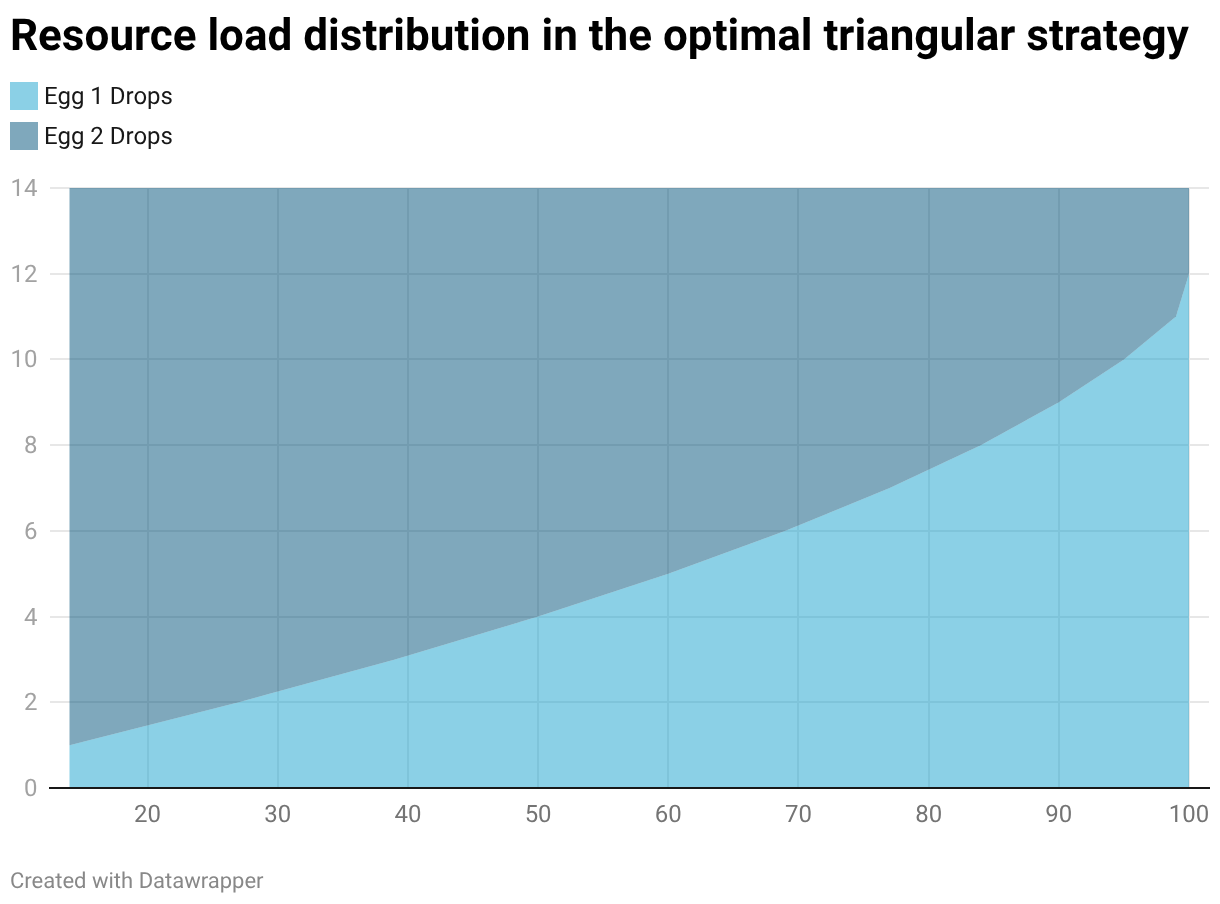
In a corporate context, this model provides a framework for resource allocation. The first egg represents calculated-risk exploration: high-impact prototypes or pilot initiatives. Its "breaking" is not failure but valuable data. The second egg is for value safeguarding and exploitation. It is deployed only after the first egg has identified a promising range. This is the incremental, low-risk work of optimizing a product or scaling a process within a pre-qualified domain, turning an initial high-risk bet into a secure return.
The two-egg problem empirically demonstrates the superiority of planning for the worst case over chasing average efficiency, especially when resources are finite and failure is costly. This approach is essential in environments prone to "Black Swan" events, where the impact of the highly improbable can be devastating if not structured correctly [4]. True corporate agility lies not in disorganized "fail fast" mantras, but in structured resilience. The critical question for leadership shifts from "What is the fastest path to success?" to: "What is our maximum failure budget, and how can we structure our experiments to guarantee a solution without ever exceeding it?" This mindset moves an organization from reactive risk management to the proactive construction of resilience.
References
[1] Richard Bellman. Dynamic Programming. Princeton University Press, Princeton, NJ, 1957.
[2] Donald Ervin Knuth. The Art of Computer Programming, Volume 3: Sorting and Search ing. Addison-Wesley Professional, 2nd edition, 1998.
[3] Moshe Sniedovich. Dijkstra’s algorithm revisited: the egg-dropping puzzle. INFORMS Transactions on Education, 3(1):29–33, 2002.
[4] Nassim Nicholas Taleb. The Black Swan: The Impact of the Highly Improbable. Random House, New York, 2007.